FOR IMMEDIATE RELEASE – Jeddah, KSA — 20 January 2025 — As the UIM E1 World Championship prepares to enter its Season 3 in 2026 this week in Jeddah, Westbrook Racing is offering an early technical insight into what it takes to race the all-electric RaceBird at the highest level. In this Q&A, Matt Wright, Race Engineer for Westbrook Racing, lifts the lid on the engineering challenges that define E1 competition.
Alongside his role with Westbrook Racing, Wright is a mechanical design and simulation engineer working on electric powertrains at Mercedes High Performance Powertrains. Drawing on experience from the pinnacle of single-seater racing, he explains how Formula One level engineering principles translate into an environment where the racing surface is constantly moving and conditions change lap by lap.
From driver controls and energy management to powertrain architecture and data interpretation, this Q&A offers media a forward-looking perspective on the technical realities of racing the RaceBird—setting the scene for what lies ahead as the E1 Championship enters its 2026 season.
Q&A: Matt Wright
Race Engineer, Westbrook Racing E1 Team
Q: Matt, can you introduce yourself and your role with Westbrook Racing?
Matt Wright: By day, I am a mechanical design and simulation engineer working on electric powertrains at Mercedes High Performance Powertrains. Outside of that, I serve as race engineer for Will Smith’s Westbrook Racing E1 team. While those environments appear very different on the surface, they share a surprising number of technical challenges once you start analysing them properly.
Q: At first glance, Formula One and electric powerboat racing seem worlds apart. What connects them?
Matt Wright: The environments could not be more different one operates on a rigid, predictable surface, the other on water that is constantly changing. However, the underlying engineering problems are remarkably similar. Both disciplines revolve around managing stability, energy, balance, and control. In E1, those challenges are simply expressed through a medium that refuses to remain constant.
Q: How complex are the driver controls on an E1 RaceBird?
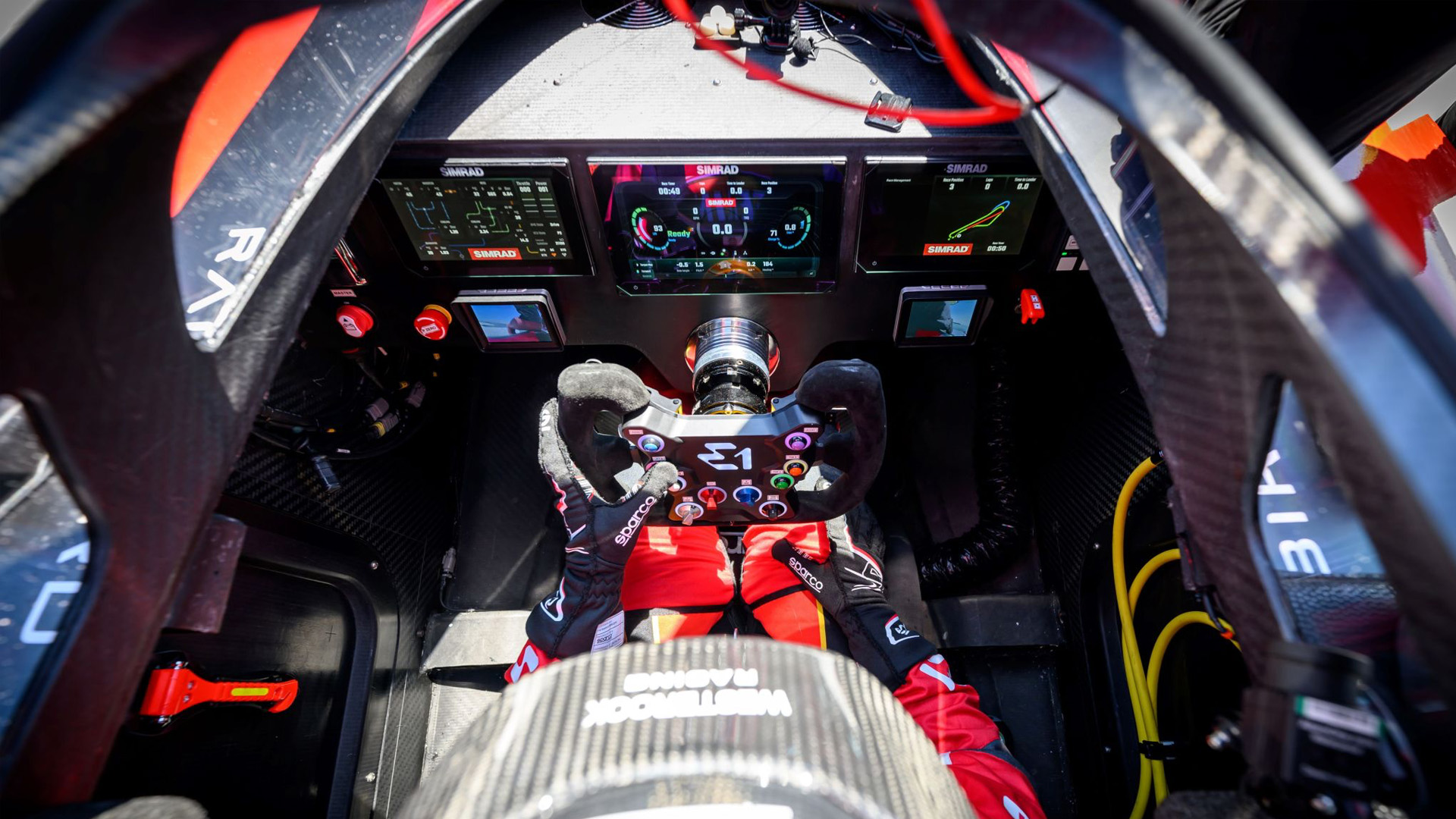
Matt Wright: On paper, the controls look simpler than those of a modern single-seater race car. In reality, every input is deeply interconnected and tightly coupled to the state of the boat in the water. Steering, throttle, trim angle, lift height, and boost are all influencing one another continuously. The driver is in a constant battle to maintain stability while extracting performance.
Q: Can you explain how steering and propulsion work on the E1 boat?
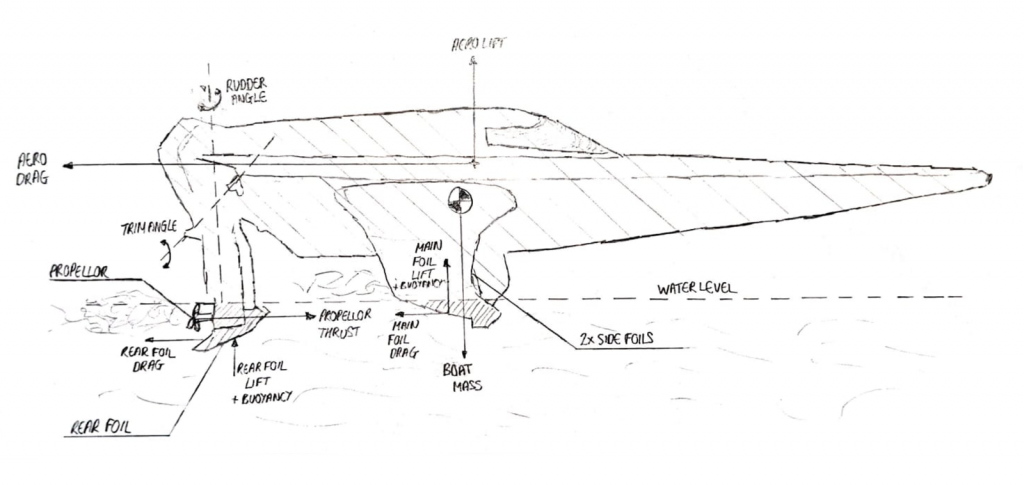
Matt Wright: Steering controls both the rotational angle of the propeller and the rear foil. The propeller itself is selected from a fixed range of pitch options, which effectively act like gearing. Lower pitch delivers stronger acceleration with reduced top speed, while higher pitch offers greater top speed with less initial acceleration. Propeller choice is driven by water conditions and density, making it a critical pre-race decision.
Q: Throttle sounds straightforward—what makes it different in E1?
Matt Wright: While throttle delivers power to the propeller rather than tyres, it does far more than control straight-line acceleration. Throttle can be used as an indirect ride-height control and as a load-transfer mechanism. Small changes in throttle input can significantly alter how the boat interacts with the water and foils.
Q: How important is trim and lift management?
Matt Wright: Trim angle sets the pitch attitude of the boat and effectively controls the angle of attack of the foils. Too conservative and the boat digs into the water; too aggressive and stability is lost. Lift height, which hydraulically adjusts the rear foil and propeller assembly, changes the forces generated at the rear that must be balanced by the front foils. Together, trim and lift are critical tools for maintaining control at speed.
Q: Boost plays a role in race strategy—how do teams approach it?
Matt Wright: Boost provides a short-duration power increase, with a total allowance of 20 seconds that regenerates incrementally. Using boost is rarely about peak lap time. It is an energy allocation decision choosing where to deploy a finite resource in a race that is fundamentally energy-limited.
Q: The powertrain is often described as where E1 becomes genuinely new. Why is that?
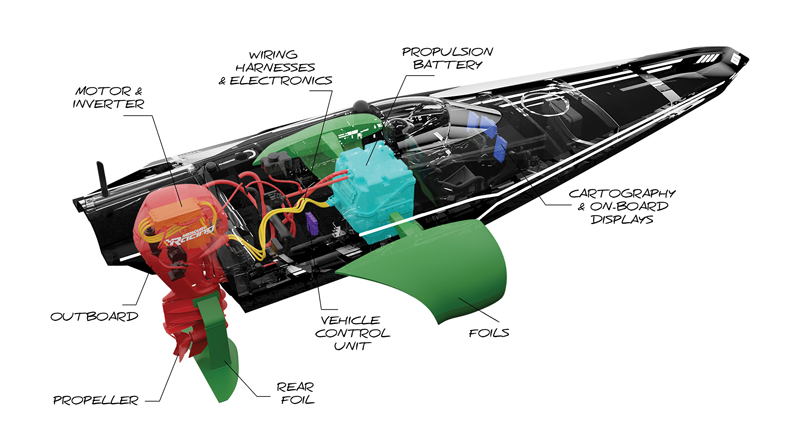
Matt Wright: The Mercury Racing E1-X outboard is a world first. Traditional offshore powerboat racing can exceed 2,000 bhp using twin inboard engines. In contrast, the E1-X delivers 150 kW, or roughly 200 bhp, via a permanent magnet synchronous motor integrated directly with its inverter. Packaging the entire powertrain into a clean, self-contained outboard unit is a significant technical achievement.
Q: What makes the battery system unique?
Matt Wright: The RaceBird uses a 35 kWh battery developed by Kreisel Electric, comprising 3,312 lithium-ion cells. Unlike Formula One, there is no energy recuperation under braking, so the battery operates under a very different duty cycle. Immersion cooling is used, with the cells submerged in a dielectric fluid, providing excellent heat rejection but also introducing significant engineering complexity in terms of sealing and system integration.
Q: How does data analysis differ from traditional motorsport?
Matt Wright: The tools are familiar we use high-resolution telemetry and analyse data in McLaren ATLAS software, much like Formula One. The challenge lies in interpretation. Water is a dynamic, energy-storing surface. Currents, wave patterns, and even nearby marine traffic can introduce lap-time variations of several seconds. Metrics that are stable reference points in circuit racing are far less reliable here.
Q: How do teams compensate for those variables?
Matt Wright: Limited testing time means you cannot rely on data alone. Decisions are made by combining telemetry, driver feedback, visual observation, and experience. Instinct still plays a meaningful role. That balance between engineering rigour and real-time judgement is one of the most fascinating aspects of E1.
Q: What is your overall assessment of the E1 Championship from a technical standpoint?
Matt Wright: E1 may appear straightforward at first glance, but beneath the surface it is deceptively complex. The fundamentals control, balance, and energy management are the same problems we solve in Formula One, but expressed in a medium that is constantly moving. That is what makes E1 both challenging and genuinely exciting from an engineering perspective.
— END —